
.png?width=300&height=74&name=MorelandU-logo-WH-RGB%20(1).png "Moreland University Logo")
Front of the Class Podcast | August 6th, 2026
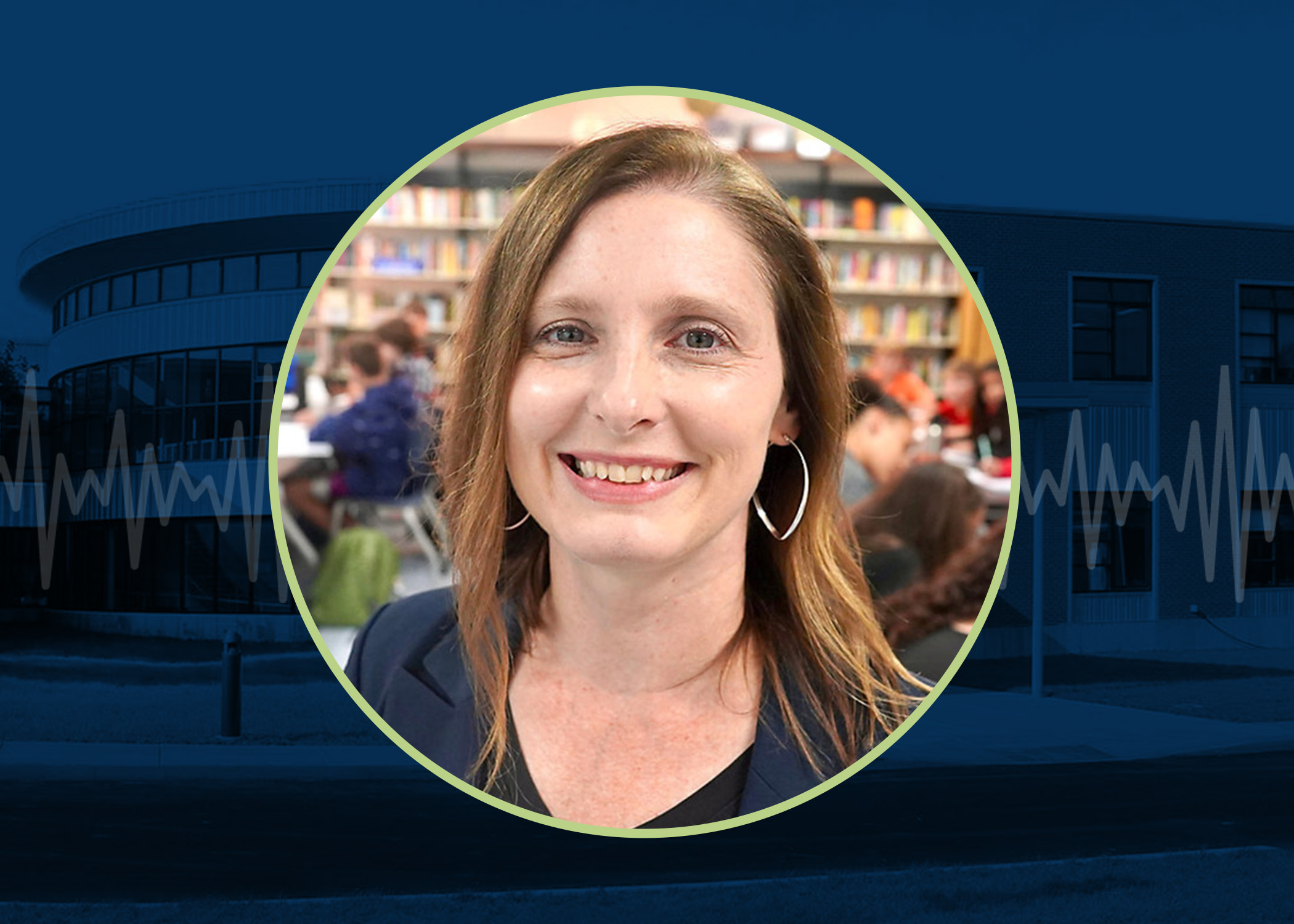
Championing Curiosity with 2025 Kentucky Teacher of the Year Jennifer Montgomery
In This Episode
Jennifer Montgomery has spent more than two decades helping students build confidence, think critically, and connect classroom learning to the world around them. Throughout that time, the 2025 Kentucky Teacher of the Year career has prioritized curiosity, creativity, and meaningful relationships in her classrooms.
In this episode, Montgomery shares how project-based instruction and building strong connections with students can be inspirational starting points for the rest of their lives. With practical ideas for creating engaging lessons and helping students develop real-world skills, this episode has something for new and experienced teachers alike.
Key Topics Covered
- Why curiosity fuels student engagement
- Bringing real-world learning into the classroom
- Building teamwork through project-based learning
- Helping students discover their strengths
- Preparing future educators with authentic experiences
- And more!
Episode Guest
Listen Now




Episode Transcript
Please note, this transcript is generated by AI and may include some errors.
Spencer Payne: Okay, here we are, front of the class, real stories from real educators. Our real educator today is Jennifer Montgomery. Jennifer, can you share a little bit about where are you coming at us from and how do you introduce yourself to other educators? How do you how do you share that story?
Jennifer Montgomery: Sure. So I think when we are invited to introduce ourselves, we're often tempted to say things like, I've been teaching for twenty-four years. I've taught every grade level from K to twelve, and all those things are true. But a couple of years ago I got to hear Dr. Mary Hemp Hill. She has a book called One Minute Conferences. And she shared that when we really start our story that way, we're starting with a list of our human doings.
And I think when we start with our human doing rather than who we are as a human being, we whether we mean to or recognize that we do, we often put up a wall. And the people that we're speaking to, maybe they can, maybe they can't really relate to us. So I just like to introduce myself in a really real way and say that I grew up in Kentucky. I currently live in Kentucky. I've lived here all my life. And I grew up in a three-room home that didn't have running water, didn't have telephone service. And I had wonderful teachers from K through twelve who certainly shaped me, impacted me, and pointed me, even though I didn't realize it at the time, pointed me on my path to teaching.
Spencer Payne: How did they point you on that path? What did what did you see in those teachers coming from that background that made you say, I I wanna do what they're doing? Or did they inspire you? Like what what what what got you into into looking at what they did and said, I want to do that too?
Jennifer Montgomery: Yeah, I don't think it was I didn't know that I wanted to do that for a long time. So a lot of my colleagues, they knew, they've always known that they wanted to become a teacher. It's what they've always wanted. Some of them tell stories of lining up their stuffed animals and like pretending they were in their classroom. I definitely tried that with my brothers a couple of times, but it was more of a punishment. They didn't really take well to it. so it was more that they they saw things in me before I could see those things in myself and I just later on when I was in college, my parents don't have college degrees, but they are fully supportive, wanted me to have the opportunity to go to college and study whatever I wanted to. So I didn't really know what I wanted to do or who I wanted to be, but I did know that I love literature. So I decided to just study English because it's what I loved.
And so my senior year of college, somebody, and I don't even remember who it was, it might have been a professor, it might have been a friend, but somebody said, have you ever thought about teaching? You know, my extended family this whole while has been saying, What are you gonna do with an English degree? And I didn't really have a quippy answer, but I also wasn't really super worried about it. I, in my young, naive mind, I was like, there's thousands, there's millions of possibilities. but this this friend or whoever it was asked me, have you ever thought about teaching? And I really quickly said no. And it really was just an honest answer that I just never thought about it.
But once that question was posed, like I just kept turning it over and over in my mind and couldn't quite shake it. So I graduated in May of 2001 and by June of 2001, I had entered a master's program in education to pursue that career. And I'm still here today.
Spencer Payne: So you did your masters immediately. Can you share a little bit about is the reason because cause you didn't study education as an undergrad that you thought, like I I really need to do this to make sure that I'm well equipped? Or can you share a little a little bit more about why choosing you to do your masters at that time and knowing what you do today like knowing what you know now, would you still do it that same way?
Jennifer Montgomery: Yeah, so you already kind of hit on it. So I I only study the English literature. I didn't study education at all. So before stepping in the classroom, I had to have some education training as I should have to learn about classroom management, to learn about education law, to learn about so many things. And so I did a really intensive one year program. So it wasn't just two semesters, it was literally a full year, so summer, fall semester, spring semester, another summer and it was a really fantastic program. So I mean, nobody really feels once they step in their classroom and they're experiencing things, like I felt like I had as great training as I could have had. Once you're living it out, it's certainly different and you certainly learn new things and have a thousand more questions. but yeah, I think it was a great step and a great move for me to to have that because like I said, I didn't have any training and education, so I definitely needed that.
Spencer Payne: And then let's flash forward a little bit to your first year in the classroom. Do you remember how how do you remember feeling about it? Like do you remember feeling like, wow, this is definitely it for me? Do you remember feeling like, my gosh, the stuff that I learned in my masters was pretty good, but I'm no not even close to prepared to actually do like how did you feel that first year? What do you remember?
Jennifer Montgomery: Yeah, so I had a thousand emotions. So I'd say it didn't even differ from day to day, but from moment to moment. I didn't ever really think about, I think I'm in the wrong career. I never had that thought. but I definitely just had so many questions. So I really feel like I had two first years in a row. So my very first year teaching, I taught at my alma mater.
And one of my high school English teachers that I admired and looked up to was still there. So she definitely mentored me that first year and helped me learn a lot of things, helped me survive, helped me it just helped me in lot of ways. But that first year, you know, it was hard as a learning curve. I was 23 years old. I was teaching sophomores, juniors, and seniors, which is what I knew I wanted to do. I knew I wanted to be a high school English teacher because I had the most amazing high school. English teachers. Had amazing teachers all the way through school, but my high school English teachers really looked up to them. And so I just knew that was my path. but that was a long commute for me. It's a 45 minute commute, and I don't like driving, so it felt like a lot.
So I decided to take an interview, and I accidentally took an interview for a middle school teaching job and didn't realize that that's what I was interviewing for. I stepped into the room and there was a room full of six or eight people there to interview me. And that's the moment I realized, my gosh, they're interviewing me for a middle school job. But it felt awkward to leave, so I stayed for the interview. They offered me the job. I thought, well, okay, this is a K-12 school, all in one building. I can take this job, and sometime in the next few years, like a high school position will open up. I can move up. It's not that big of a deal.
And then what happened is I fell in love with middle school, something I never could have predicted, something that I didn't even mean to do. I didn't even mean to be in that space. and I had another first year all over again because it was a totally different I went from sophomores, juniors, and seniors to seventh graders and eighth graders who I never imagined myself teaching, who were very different in almost every way. and so I relearned everything all over again, again had some great mentors, and I just I continue to teach some high school electives. I've I've taught, you know, some high school classes for you know the past couple decades, but really most the majority of my teaching has really been seventh or eighth grade, mostly seventh grade English.
Spencer Payne: And this transition from high school to middle school, can I like to jump into this in a little more depth? Can you share a little bit more about you know you say now that that was not your intention, but now you've fallen in love with it and you stayed there. Like what what are some of the biggest differences between teaching English to or or maybe generally teaching to high schoolers versus middle schools and middle schoolers and specifically about the middle schoolers?
What are some of the things that light you up that made you say, I never thought I'd actually want to be here, but now I want to stay here? Like what what about it? What about that age lights you up?
Jennifer Montgomery: Most of all, I love their curiosity. I love that middle schoolers, and they come in, they're it's a super awkward stage of life. I mean, I would never want to go back and relive middle school years ever. I remember them vividly. but also they're just they are really full of life and figuring out who they are, and they're not afraid to ask questions that to some people, might sound really wild, really out there. They they say they don't have as much of a filter. They kind of say whatever's on their mind. And I just I love that about them. And I love that they that they still want to learn. You know, one thing I did find in high school that was a little tougher for me was just getting buy-in from students because especially when I was teaching seniors, you know, senior it is hits really before I have a senior right now, he's going into a senior year.
He's already telling me I'm ready to be done. And he hasn't even started his senior year. so that was a challenge. but yeah, seventh and eighth grade, especially seventh. I don't know, seventh grade is my favorite. I've really, in some form or fashion, I've taught every grade level from K to 12. And seventh graders, I just you know, it's like being the middle child. They're in the middle of middle school. They're not eighth graders feeling like they're on the cusp of, you know, high school.
They're only a year out of elementary school. They're stuck in the middle, but they're these wonderful humans who where else can you show up at work and have a girl you've just met for the first time walk up to you and recite an Emily Dickens poem and say, Here, I have a copy, an extra copy if you want it. so yeah, I just I just love I love their energy, I love their curiosity.
Spencer Payne: And what are some ways that you're teaching kind of strategies or some of the things that you do? What how did you approach teaching seventh graders differently than than high schoolers? Like what are some things that you maybe you took from high school and you applied to seventh grade and you're like, that's not gonna work here anymore? or some things that maybe, again, you s you started doing more of or stopped doing to tailor more to that seventh grade audience compared to high school? What are some things that you did or did not do?
Jennifer Montgomery: Well, I think this is not a specific thing, but it's more of a general philosophy. And I actually kind of learned this from my husband, who was a middle school football coach. and he said something that I've never forgotten that whatever you're gonna do with middle schoolers, you have to practice it first. And he said he was talking about if you want them to run through a sign on a ther we had Thursday night games for middle schoolers. If you want them to run through a banner, then you gotta practice it. Because if you don't practice it, it is probably not gonna go the way you want it to and so I started thinking about that when I was, you know, teaching and I thought, you know, like this is really true. Like, I can't just say something and expect it to happen. We we have to practice it like it's going to be.
And so I started at the beginning of the year, instead of, for example, going through a big list of rules, I came up with just real life scenarios that I've seen a million times, like, I left my homework at home, I don't have a pencil, I don't remember what the homework assignment is, just a million different small scenarios. and just the first week of school, like we practice I hand those out and I have the kids form or form little groups and they practice good and bad ways to handle those situations. And so right from the beginning, like we're just practicing what does it look like to be a student in this room?
Spencer Payne: Hmm. I I do remember I I think this was I think this was actually seventh grade, I think. I don't remember exactly, but I think it was maybe sixth grade, seventh grade, playing basketball. And I think I was supposed to call a timeout. And I don't think I had ever actually called timeout in a game ever. Right. Even though I watched it happen a million times on, you know, college games or NBA games, I had never actually done it. Like we never practiced it. And so I remember the coach from the sideline being like, call timeout. And I had the ball. I was and I I instead of like holding the ball and looking at the ref and calling timeout. I like dribbled it off to the side. So it's just bouncing next to me and I was calling timeout. And the ref's like, What are you doing? You don't have the ball, dude. so anyway, si similar example of like something as dumb as like, Hey, call timeout. I'm like, Well, I've actually never done this before. Like before I do it in a game, maybe we should probably do this in practice, like the basics of like, what do you have to do to call timeout? Similar concept there for
Jennifer Montgomery: Exactly.
Spencer Payne: practicing these things before you do them live with your with your seventh seventh grade students one thing about these these kind of transitions that that you had also shared was, you know, this transition from high school to middle school teaching, you know, seventh graders especially. And now you're you're in process of of another bit of a transition. Can you share a little bit about what that is and why you're fired up about that?
Jennifer Montgomery: espectfully and now you're the stuff.
Yeah, so I am about to go full circle and go back to high school. shout out to Martha Lane Collintai and Shelby County High, which the two schools that I'll be working at. but what I'm doing there is I have this incredible opportunity to be in what's called the teaching and learning pathway. So I'll be walking alongside high school students who are interested in the teaching profession and just be helping them kind of discover if this is the path that they want to follow. And so I'm really excited about that because I'm, you know, I'm 24 years in and there's kind of no better way that I could imagine leaving the the profession than to pouring into the next generation of educators.
Spencer Payne: and how did that get started? Like, is this something that you sought out? Did people ask you and you thought about for a couple of years, maybe no, no, no, and then said yes? Like, how do how like for for others maybe who are out there who are educators who are wondering, like, I've been doing this for a long time, I want to get involved in other things? Can you share a little bit about how that came about for you? And and and that as an example for how other educators might approach, hey, I want to get involved in something else. How do you find out about other opportunities beyond simply teaching your classroom, which is perfectly fine, but if folks want to do more?
How did this come about and how would you advise others think about getting involved in in other broader things like this?
Jennifer Montgomery: There's probably lots of different ways. I have a tendency, you're probably gonna notice this theme coming up of just just conversing with people, just talking to people. That's kind of how the opportunity came up for me. I actually got interested in the teaching. I didn't even know about the pathway, which has been in my state for several years. but through my ambassadorship as teacher of the year, I got to work with our department of education and learn a lot about it. I was really interested in it.
I was going to go to my administrators at the school. I taught for over two decades at the same school. And so I was going to go to the administrators and talk to them about starting the teaching learning pathway at our school. And before I could do it, they beat me to the punch and sent out an email saying, We would really love to open the teaching learning pathway at our school. Who is interested? And so I jumped on that boat and was able to start conversations with partners. So we did a partnership with a local university that was pretty nearby and that was a fantastic partnership. And so I have a little bit of experience doing this. Although I will say last year was my first year in the pathway. And so I definitely learned a lot of things along the way. But the o the new opportunity came about just from having conversations, you know, just having conversations with people in different districts and learning about what their districts were doing and the teaching and learning pathway. And then well are you open to talking to somebody about that in our district? Sure, I'm open to talking to somebody and just, you know, conversations happening back and forth. and then, you know, just an opportunity the position itself opening up. And so that's kind of how it came about for me.
Spencer Payne: And what do you hope to accomplish with this? Like what what's what are some things that you hope you can say maybe at the end of next school year of like, I hope we and I was able to do X, Y, or Z. Does anything anything strike you that you're hoping to accomplish?
Jennifer Montgomery: Yeah, I'm really excited to work with this new group of students. And it's not that all of them will end up deciding, yes, I want to become a teacher. But I think sometimes like it's really important to understand or to recognize pasts that aren't right for you just as much as it is past that are right for you. And so for me, the measure of success is a lot of different things. I know for last year I had on day one, because this was the first year of our pathway, I had nine students in this class. These are dual credit classes. So nine students in the class, and I just wanted to get a gauge. And I said, raise your hand if you are genuinely interested in teaching as a profession. Because I know how things go when a new course or pathway gets started and people get signed up for various reasons. Maybe they just see it's dual credit, maybe they don't even know what it is. Zero hands went up when I asked this question.
So I didn't let that deter me. And I just asked them, well, since you are in this course and you're not thinking of pursuing the profession, I'm just gonna ask you to dive in with me anyway, and know that teachers, the skills that teachers have can be applied in so many different ways and so many different paths and so many different careers. So will you just jump in with me? And they did and so I had one girl who stayed after class one day about a quarter of the way in. We were right before fall break, and she said, I just want to say, my mom has always told me I would be a really good teacher. She said, You know, my sisters, my sisters are both here, they work at the school, they're teachers. but I really didn't think it was for me until I started taking this class. And now that we're only like nine weeks in, I know it's what I want to do. By the end of the of last school year.
She had not only like a four-year plan. She was a sophomore. So she had a plan for what she wanted to do for the rest of high school to make this possible, but also for college. And I mean, so so many ideas, so much excitement. and so I'm hoping definitely to have some of those kinds of experiences, just helping kids get ignited and helping students realize maybe that this is a path they want to follow. But like I said before, also learning if this isn't your path, that's okay too. why not learn that now? Then you know, when you're already invested in a college degree, and then you realize this is not something that I'm really passionate about. but I also love so part of this program is the students go into real classrooms and they are assistants in these classrooms. They are secondary teachers, you know, they are teaching small groups of kids, they are mentoring, they are tutoring. And seeing how much they grow and they learn from those experiences is also really powerful and really impactful.
Spencer Payne: yeah, one one one one thing you said there was about hey, there's even if you take this class and don't become a teacher, there's a lot of things you can learn here about kind of what it takes to be a teacher that you can apply to other things. and as a quick a a quick kind of example, I made a joke the other night. my three and a half year old, I don't think anyone should ever be a lawyer unless they've actually dealt with little kids because you see all the ways that you can like winnow out of a contract.
Like it was like, all right, we're gonna do two puzzles and then we're gonna go to bed. Right. And then by the time we got to the last two pieces of the second puzzle, it was, you know, all of a sudden we're we're going super slow motion and we're purposefully putting the puzzle in the wrong way. And it was like, okay, okay, we're gonna do two puzzles before bed, assuming you're making a good faith effort to actually do the puzzles. And it was like,
Where I again where I go with that is like until you have these like these little kids who are like trying to figure out ways to work around what you just said. Right. Like I can see how that's a very useful skill to see that and then be a lawyer of like, well, how would somebody get around this? Like my three year old would try to get around this. So I I share that example in the context of what what what are some other things, for example, that that you see again, maybe being a a mom or or other folks you know are teachers, where some of these skills you have as as a teacher or preparing to be a teacher could apply in in other regards, maybe being a parent or somewhere else. Like what what what you I'd be curious to hear what what else what else do you see there?
Jennifer Montgomery: Well, the very first thing that comes to my mind is I do this inventory with my students at the beginning of the year. I know a lot of teachers do similar things, but I really love this one. It's called True Colors. And I love it because the purpose of it isn't to kind of box people in and say, you are this is your personality, this is your personality. Like the point of it is like we all it's four colors.
And we kind of all have pieces and parts of all of those things in us, but we do have dominant traits. And so I use that as an opportunity to help students learn about themselves, but also sit to say, now think about what this means for you when you are not just working with other people in school, but let's say that you want to approach your parents about something that you don't know if they're gonna be too crazy about. Well if you know that your mom is a gold and that that means that she cares a lot about rules, she cares a lot about routines, she cares a lot about traditions, you know, you know these things about her, then you think about how can I communicate this to her in a way that she's going to understand it. Not that I'm trying to manipulate her and make her like want to do what I want her to do, but like, how can I approach her?
In a way that's gonna help her see my point of view or see where I'm coming from. And so, even just something as simple as that, I use that even with my high school students as well, because it's a way to understand yourself, but it's a way to understand other people. And it's a way to say that we all bring strengths to the table. We all have challenges, we all have things we're not great at, but we also all have strengths. And so it's really great to know when you're working on a team.
That with a team that like these are the strengths that we're all bringing to to the table. But also, this is what I know about myself. Like I've heard I've heard students say I have team, I have them do team contracts. and again, these are things that I think apply or could apply, should apply to the workplace. team contracts. And when they're filling out their team contracts, they're telling their team, these are the things I'm great at, but look, this is something I know I struggle with. Like I am a really great big idea person.
But I struggle getting things turned in on time. Like I don't always follow through. and so I think just even things like that are so applicable and can help you just understanding the people that you're working with in any setting, not just the school setting, but whether, you know, it's working with people at your church, working with people on a job that has nothing to do with education, understanding that you don't all come at the same, you might be tackling the same problem, but you don't all see it through the same lens. And you're not coming at it from the same direction. So you can either get frustrated with people because they're not doing it or seeing it or viewing it the way you do, or you can use it to your benefit and like look at it from all these different angles.
Spencer Payne: and this concept of a team contract, so can you share a little bit is is this something that you you kind of establish in your classrooms? And if so, what's what's the how how did that come about? What's the origin story of these team contracts that that you have going on?
Jennifer Montgomery: Yeah, so the team contracts go back to kind of a bigger story. So I I got to a point a few years into my teaching where my students were, I mean, I have gr I had great students. I've always had, you know, very supportive community, very supportive parents. But my students were compliant, and that's not the kind of classroom I wanted. Like I wanted a really engaged classroom where my students were really engaged in the learning. They were invested in it, not they were just doing the thing because they were supposed to do the thing.
And I didn't have that. And I really wanted that. And so I did some research and I did some digging. And I stumbled upon project-based learning. And there wasn't really a lot, there weren't a lot of models around me. There weren't a lot of teachers that were like really fully invested in project-based learning. And a lot of the trainings were in California. I a district, you know, I'm like, I they're not they're not gonna have money to send me to a week-long training in California. And so I finally found a training that was free.
And it was in Indiana, which is neighboring state for me. So I talked to my principal about it. And she was not only so excited that I was excited, she said, Do you mind if I come and do it with you? Because if I'm gonna support you in this type of work, I kind of need to understand it myself, which was amazing. And so we both went, we took our kids, they had cool like rocket camps for the kids. We did this whole week-long training. and I came back and I implemented a lot of this in my classroom. And there were a couple, I there were some things that I knew I was doing. I was rocking. I was doing really great at creating these amazing entry events, at show having these showcases of learning at the end. And then there was this time in the middle.
And I wasn't doing so great at this time in the middle, and I was trying to figure out. And every time I launched a new project, I would have, again, a really amazing beginning and a really amazing end. And then this time in the middle, and I was trying to figure out like what's going on. And so I went back to that same training. They had a 101 track and a 201 track. I went back the next summer and I took the 201 track and it was a lot more organic. It wasn't as planned with like we're going to teach you like these essentials of PBL. It was more like, let's see what you all are struggling with and let's see like what we can figure out. And so I stumbled on two things with their help.
One was the use of benchmarks. So not just the beginning and an end, but having help helping kids see the benchmarks that we're going to help them get from that beginning to that ending. And then the other thing was I was introduced to team contracts. And so I loved that concept and I developed, you know, I I kind of put my own spin on it. Like one of the things, like I mentioned the true colors. So even though we do that survey at the beginning of the year, if we're in January and we're launching a new project.
Kids are still gonna be putting on their team contracts, like, this was my dominant color, these are what my strengths are, these are some things I've learned about myself that are that I know I struggle with. That's what they do at the beginning of the contract. They also are putting contact information on there, and I leave that up to them. Say do what's comfortable for you. If school email is what's appropriate because that's what your parents say it's appropriate, that's what's comfortable for you, just do school email, that's fine. You just need some sort of way because you don't know when you're gonna get sick. You don't know when you might have an unexpected doctor's appointment that you didn't tell your group about the day before because you didn't realize you have that appointment. You need some way because it's your responsibility. You were a part of this team, and it's your responsibility to be communicating. So that goes on the contract. they also come up with they establish their own set of norms.
And so I don't make it a free-for-all in that it's not just a blank page, but they're coming up with whatever in the world norms that they want, but they have some categories like you have to have a norm about respect. You have how what will that look like in your group? so you guys get to decide that. How will you how will you communicate with each other that you respect everybody's ideas in this in this group? and so they come up with norms. They also come up with a firing process.
This doesn't get used a lot, but I think it's important and I think it gives some gravitas to the situation, the fact that they know they could get fired from this group. and so they're not allowed to have a one-strike and you're out process. they have to have some opportunities for the person to be able to make some changes. They're not allowed to fire someone that has to come from me, and so there has to be some kind of like point where they're bringing the situation to me to say, these are the things that we've tried. We all agreed to this. We've done step one and step two, which are usually something like having a conversation with the person, or we talk about giving someone a specific responsibility because sometimes we assume people are not contributing because they're lazy, because they don't care. Sometimes they're not contributing because they don't know how. They don't know like how can I contribute to this? I'm not sure.
So usually a step is like asking them to do a specific role or task for the group. and then, you know, if they're continuously like not holding up the team's, the team's norms and and helping the team, then they can bring it to me. We have a conversation. So it's it's a process. I rarely ever have to actually fire someone. that happened like early on when I was starting this process, probably because I wasn't as good at helping students learn how to work through. and we mentioned earlier, you know, skills that transfer over. What great skills that transfer over to because when in your life are you gonna have to work with a team where you love everyone on your team, and you are just
Spencer Payne: Unf unfortunately almost never. If only it worked out that way, but it doesn't always do it that way.
Jennifer Montgomery: Exactly. And there's always the the difficult person and sometimes you're the difficult person. and so, you know, I just it's been it's been a really powerful tool that I've used in my classroom and it's been I think really useful for students and I have like I've been excited to walk around and hear some of that happening. to hear someone say, Okay, Spencer, you know, we realize that we're we're at a point in our project, it's due really soon. And it feels like you maybe haven't contributed a lot, but we know that you're really great at this. And so we really just want to know, can you work on this for our group? and to hear, you know, some of those responses like, yeah, I think I can do that. you know, that's really exciting. And then also it's the idea too, like we talk about how everybody has bad days.
You might have a day where you cannot work with your team because you are just not in the right headspace. It's just your responsibility to communicate that to the team. So I need to work on my own today. I'm not saying I won't do anything. I just need to have a task where I can just work independently and still contribute to the group that way.
Spencer Payne: project based learning. For those who are maybe unfamiliar with have never been to this training that you got to go to or unfamiliar with the concept, what can you share to also tie back into your kind of one minute introduction speech at the beginning? What will be the one minute intro of project based learning to you?
Jennifer Montgomery: One minute intro is hard. so I guess I would say it's the idea of grounding learning in real life and connecting it to as many different, like creating as many real life connections as possible. So that's my short intro, but I want to give you an example. So for example, a project that I always or that I usually use with my students at the beginning of the school year is based around water scarcity.
I also, you know, try tie in my own personal experiences. I tell my students that I grew up in a home with no running water. Now I did not have to personally walk and go and collect the water, but I do know what it means to not be able to turn on a faucet and just have water easily come to you. I know what that means. And so I share that experience. But part of project-based learning is creating experiences for students to be able to walk in the learning themselves, even before you're naming it. So on the very first day of this project, I start it by having them make a list. Write down everything you can think of in the last 24 hours that required water. And so they make these lists. And then the very next step is not teaching or learning about this book or about this concept. The very next step is I walk up to the front of the room, I pick up a gallon of water, I say, everybody come up and pick up a gallon of water. We walk outside.
We go across the street to our football field and we walk a mile around the field carrying our water jugs. Then we sit down, then we have a conversation. Think about all the things you did. You said you wrote down at the beginning of class that use water. What if you had to go collect all that water for your family or for yourself? What would that mean? Like what would that change? And so now there's curiosity.
And now there's buy-in, and I'll never forget the very first time I did that. And a kid almost almost within a minute or two said, wouldn't that create a cycle of something that would just keep happening like generationally again and again? If if this is just what your life is like, because you wouldn't be able to go to school, so you wouldn't really have a way to like have a different kind of experience. and so for for a kid to understand that j just mean. That walk takes 20 minutes, and already he's understanding things at levels that if I stood up in the front of the classroom and I tried to teach about this, it just it really wouldn't hit home in the same sort of way. so there's there's entry events like that, which are always meant to just make the the process or the or the content just immerse students in it. I'm an English teacher, I'm always tying in science and math and history. so that's another really important piece.
I think one way we get it wrong in education sometimes is we pigeonhole everything into its own box. Science is over here. You'll learn about that in science class. that's history. Well, we're not to talk about that. You'll learn about that in your history class. But in real life, it doesn't work that way. Everything is connected. Art and music and math and science and English and history and language and everything's connected. So every way that I can think of to pull in and make those connections. I do that. So in the water project, we're trap we travel to just 45 minutes down the road to a treatment plant, and we learn about what happens when our water is pulled out. Our water is coming from the Ohio River. When it's pulled out of the Ohio River, what happens to it before we turn on our tap and we get it? Like there's a lot of things happening. So like we're learning about that.
We go to another local place that's nearby called Water Step. Waterstep exists to help people all around the world, both in the US and globally, to gain access to water. When we travel there, it's really cool. For the last 10 years, that trip has been really special. I say 10 years or so, that's just an estimate because one of my former students actually works for this organization. And so it's also an opportunity to say, where you come from. never limits where you can go or who you can be. Like he sat in the same seats that you're sitting in. He had some of the same teachers that you currently have. He came from the same town. He graduated from the school and he is literally working for this tiny little organization that is having a huge impact helping people all around the world gain access to water. So it's also about like opening up kids' eyes to those kinds of things. com bringing in the community, whether it's bringing them into the classroom or whether it's taking the kids out into the community is another important piece.
And then the last piece that I would share is just always having a real world audience. It definitely ups the ante when kids know the work I'm doing is important and it's important enough that I'm not just turning it into my teacher. It's not just going to her to be graded. It has something bigger, something more meaningful. So for the water project, they end up teaching third grade students who are learning about the water cycle and learning different things in science. They end up tea they research my students form small groups and they research different pieces of water scarcity or just different aspects of that.
Like one group might pick the life straw and I had a group one year who picked that as their topic and they learned everything that they could learn about the life straw. And then they emailed the company and they said, Hey, we're gonna teach third graders about your life straw. We thought it'd be really cool if we had one, but they're like $20 and we don't have $20. Life straw sent them two life straws. so just for them, like learning how to do those kinds of things as well. And then just that presentation piece at the end where they're not only showcasing their learning to just say, see what I know.
Spencer Payne: Nice. Nice.
Jennifer Montgomery: But they're also using it in a really authentic way.
Spencer Payne: that was a fantastic example. a couple of quick questions here. One one is, you know, so you're teaching English and you're having kids walk a mile around a football field carrying water. If I'm an if I'm also an English teacher somewhere else listening and I'm thinking, I want to do some more field trips. I'm English. Like I never get to do all the cool stuff. How I guess, how did you tie that into literature or how did you sell that to your principal? Or like how did you get that how did you get that started?
If someone's out there like, I want to do more field trips as an English teacher, but I just don't see the relevancy of how I can pull that off, what might you suggest to someone who might be thinking that right now?
Jennifer Montgomery: before we actually learn about it. So that's one thing. so to me it's a very, very direct connection. as far as administrators, I think that inviting them in to see what's happening in your classrooms when these types of things are happening gets them to buy in quicker than anything else. They might not buy in on paper. Now I'm I'm very fortunate. So the district that I was at for over 20 years had incredible leadership and we're just...
They actually encouraged us to be creative, to think outside the box, to not worry about breaking norms and things like that. I do give them credits and say that they are a big reason that I became the teacher that I am today. But even if I didn't have their supportive leadership, I think inviting them into the process along the way, like inviting them to come see this water walk and hear the conversation that follows it. Nobody who hears that conversation is gonna say, why are you doing that? Isn't that a waste of time? once they hear the student's thoughts and thinking like, they're not gonna be wondering why are you doing this?
Spencer Payne: and going back to the water treatment plant kind of field trip, that sounds that sounds incredible. Like that's good real world, actual, like, yeah, how like how how what happens when I how do I get clean water when I turn on the faucet? Like what has to happen for that to be true? I could also imagine seventh graders potentially being like, you know, bored or not as interested as you might hope that they could be by this. I guess is the when you the first time you took that field trip.
I guess what you hope for, did it actually did the kids actually respond to the level of curiosity, interest? that's how that works. Did they respond to the level that you hoped? Did you have to coax a couple of things out or maybe precede some questions to the the folks working at the at the treatment plant to help kind of coax some of that curiosity? Or like how again, how did you kind of how did you kind of help aid making sure that that was a good, useful, fun, interesting experience for your kids?
Jennifer Montgomery: just the way you would any field trip. Like we we didn't just say we're going to the water treatment plant on Friday. Have fun, guys. You know, like we're talking about it in class. We're preceding, you know, leading up and we're thinking through questions, like questions we already have that we think maybe they could answer. And so we're talking about those in things in class beforehand. I really didn't prompt the people at the treatment plant other than I did give them context so they knew.
Spencer Payne: Yeah. Yeah.
Jennifer Montgomery: We're reading a long walk to water. We are learning about water filtration. By the way, I also invite our 4 H, our local 4 H to come in and have the walk the kids through this building of your own water filter too. Because some of them like to come away from the experience at the water treatment plant thinking like, it's not really that hard. Like it's you know, anybody should be able to filter their water. So then we test that out and it's not quite as easy as they think. but but yeah it it it was meaningful. It was of course after I had done it and seen it, of course like I was able to guide it better like year, you know, in the in the upcoming years to think through like prompting them a little bit more. But honestly it was it was a fantastic trip even from even from the very first time that we took it. I do think that adding the we...To save you know, to save money, we go to Water Step and the Louisville Water Tower on the same day. So I do think they're very close together.
And so I do think adding Water Step was a great move when I was able to do that because that was also extremely interactive and directly related to the novel that we were reading. And so I think it was great to say like at the treatment plant, like this is kind of our reality. But also over here at Water Step, like these people are working with folks who are living this everyday reality. So I feel like that point was the point where it kind of brought it all together.
Spencer Payne: Yeah, perfect. thank you for sharing that. I love love that you're taking these kind of real world field trips, kind of grounded in how does this actually work? 'Cause I I I mean, I think it's a it's a just a really important factor in understanding how this stuff actually happens that we just all take for granted that you have the direct experience of like, well, it wasn't always this way, right? I remember when I couldn't just turn on a faucet.
We've we've lost touch with a lot of that because we've had it so good. So it's it's interesting to just go back and just say, like, yeah, what what needs to happen so that when I turn this on, it's good, clean, drinkable water. So thank you for doing these great field trips. a couple more just rapid fire, quick hitter questions as we get close to wrapping up. if f for a new teacher who is in their first year, or if you could go back and give this advice to yourself, what's the number one piece of advice to a brand new teacher?
Jennifer Montgomery: I always give two pieces of advice. One is to definitely make sure that you find a mentor, someone that's gonna give you like good, healthy, sound advice. Some I had one, Steve Metcalf at the school that I taught at for over 20 years, who literally came to my first parent teacher conference with me because it was scary. I didn't know what was gonna happen. he, you know, it was more than just this is how the coffee machine works.
You know, it was showing me like modeling in that conference, like something he always said was especially when it was a difficult conference with a student, is that he would invite the student to and say, why are we all here? And he'd let he let them think about it and whether if they didn't answer, he'd say, We're all here because we care about you, actually. And so just like modeling things, having somebody set that model for me and like going the extra mile, coming to my conferences with me to show me how to do things like that. So definitely someone who's gonna celebrate with you, someone who's gonna help you navigate mistakes because it's fine. Like you're gonna make mistakes. We all make mistakes. but and and of course teaching is it's not meant to be a solo act, even though it s sadly turns out to be that way sometimes because we get siloed the more we get in like middle school, high school, we kind of get siloed off.
But then the second piece of advice is- You're gonna do a lot, you're gonna make a lot of mistakes, but guess what? You're gonna do a lot of things well also. Track them. you know, keep some sort of box or whatever. Every little sticky note that a kid writes you that's like, this was a great lesson today. I had so much fun, as small and simple as that might be. or maybe it's a card they write you and you know it's very inspiring. It doesn't matter what it is, an email that a parent wrote you, you're gonna do some really great things and we're our often our worst critics. I know I am. I can focus in, I can hone in on all of my inadequacies. but I do a lot of things well too. And I think it's really important that we remember that, especially for a first year teacher. You're not out there just making hundreds of mistakes. You're also doing a lot of really great things. So keep track of
Spencer Payne: Yeah, perfect. And what to you is the number one best thing about this profession, education?
Jennifer Montgomery: I think the best thing about teaching for me is just watching students believe in themselves. You know, watching a kid who I know these are rapid-fire questions, but I'm gonna make this story short as possible. I had a kid last year who he was he was it was had a hard time working with other people. He had a lot of excuses. He was a self-proclaimed bad reader, bad writer. That's what she would tell me, because I'm his English teacher.
And then there was a project we were working on. I called it Voices or Stories Waiting to Be Remembered. We focused all, it was right after Artemis II launch. All the kids were in crews. His crew, they were supposed to be designing lunar landers and lunar rovers. The literacy connection was we read hidden figures, and he begged his crew to let him make the lunar rover by himself. They did not want to let him. They were scared he wouldn't do it, they didn't think he'd take it serious.
He begged and he begged and they finally just got tired and said, Fine, we'll all work on the lunar lander. You work on the lunar rover, because you didn't even get to test the rover unless your lander succeeded and protected your extra nut. so we get to the end, we're testing, their lunar lander succeeded, their extra nut survived it. We put it in the lunar rover, their lunar rover outperforms. Every other lunar rover in the classroom and in the grade level far outperforms. And they give him all the credit. And he is just so excited and he's like, I told you I could do it. And just hearing him say that and seeing them celebrate him and then him telling me later that day, I mean, I wanna be an auto mechanic. Like this is the kind of stuff I like to do. and just seeing like those kind of doors open to me, like that's the best part of teaching.
Spencer Payne: Yeah. And sometimes could potentially the hardest part when you know there's a kid who's great at something, but it just doesn't happen to be what you're you're you're teaching, right? Of like how how do you help how do you help unlock like this thing the kids are good at? instead of trying to like, well, we don't focus on that here. We only focus on this. So I'm never gonna see what you're best. So it is an amazing example where you finally got to see that kid at at his best. and last last quick question.
Any final words of wisdom out there to our teaching audience? Maybe something that you did share already that is so important, you wanna share it one more time, or something that we just didn't have a chance to say of of new final words of advice. So any new or repeated words of wisdom.
Jennifer Montgomery: Yeah, I think when we keep people at the center of what we do, the rest of the things have a way of falling into place. you know, education's important because people are important. So I think sometimes as teachers we get especially secondary teachers like I've heard people say before that elementary teachers go into teaching because they love kids, and secondary teachers go into teaching because they love their content area. And that might be true, but I we all teach people. And so if we if we lose sight of the fact that these amazing humans are in our classrooms every day, and we have this incredible opportunity to believe in them, to help learn things about themselves that they didn't know or didn't know was possible. when we're focusing on those things, then I think a lot of other things fall into place.
Spencer Payne: Well, certainly a real educator with some great real stories. Thank you so much, Jennifer Montgomery, for for sharing your your time with us. Appreciate you.
Jennifer Montgomery: Thanks.
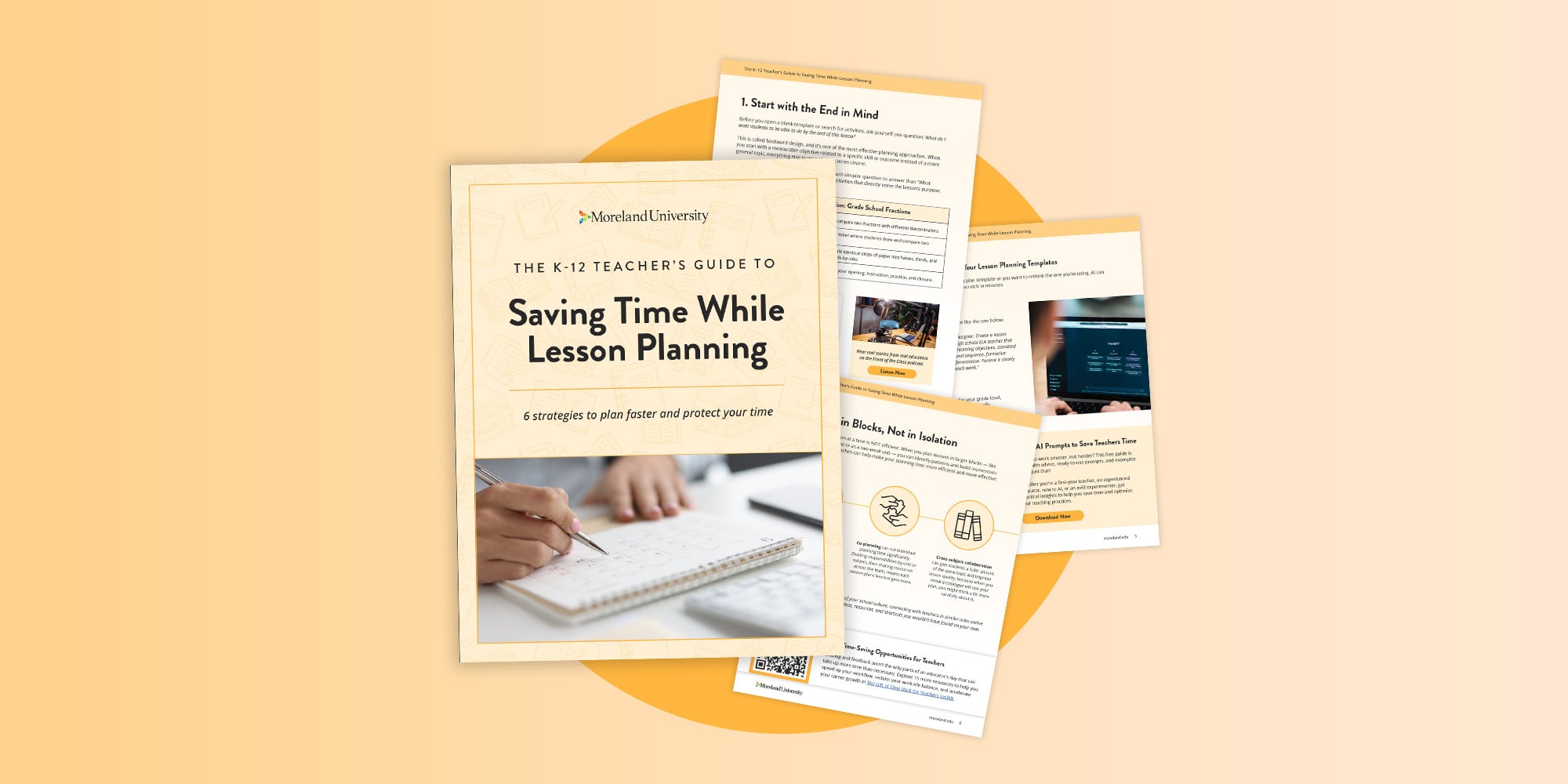



Moreland University can help you take your teaching career to the next level.
Whether you’re looking to get professionally certified or earn an M.Ed., our 100% online programs can help.
Complete your no-cost application (it takes less than 15 minutes!).